Market statistics
- Total volume
- $608K
- 24h volume
- $208K
- Liquidity
- $8K
- Open interest
- $3K
- Comments
- 3
Available prediction outcomes (19)
Sorted by descending live probability. Click any outcome to trade it on PolyGram.
Market context
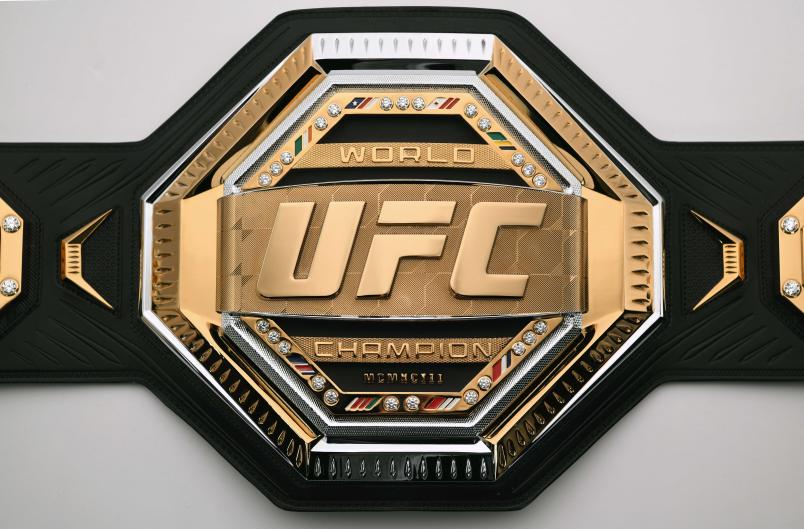
The UFC welterweight division will have a single undisputed champion on 31 December 2026, and this market resolves to "Other" if the belt is vacant on that date. The current 1% implied probability reflects substantial uncertainty about title succession across a two-year window, with multiple contenders capable of capturing and retaining the championship through the year-end settlement date.
Historical welterweight title reigns have averaged 18–24 months, meaning the incumbent champion faces realistic displacement risk within this timeframe. Kamaru Usman, Jorge Masvidal, Tyron Woodley and others have held the belt for extended periods, but the division's competitive depth—with fighters like Leon Edwards, Belal Muhammad and Colby Covington regularly contending—creates volatility in succession patterns. The 1% probability suggests market participants view the specific outcome (any given fighter holding the belt on that exact date) as highly dispersed across numerous candidates rather than concentrated on a favourite.
Traders should monitor UFC scheduling announcements for title defences and interim championship fights, which directly affect who occupies the division on year-end. Recent title fights and injury reports shape the contender pool; the UFC typically schedules 3–4 welterweight title bouts annually. Polymarket, Kalshi, Betfair and Smarkets may diverge on decimal odds presentation and fee structures, with Kalshi offering US-regulated binary outcomes whilst Betfair's exchange model allows tighter spreads on longer-dated events. The settlement window's length creates arbitrage opportunities if interim champions are crowned mid-2026, since the market explicitly excludes them from resolution.
Methodology
This page compares Who will be UFC Welterweight champion at the end of 2026? specifically across Polymarket, Kalshi, Betfair Exchange and Smarkets. The live probability is the Polymarket mid; the comparison columns summarise each venue's fee structure, KYC, settlement currency and payment rails. Every CTA routes to PolyGram, which mirrors the Polymarket order book at 0% fees.
Resolution & payout
Settlement is the biggest difference between the four platforms: Polymarket on-chain in USDC (instant), Kalshi USD via CFTC (T+1), Betfair and Smarkets in local currency via bank withdrawal (T+1 to T+3). On-chain settlement clears in minutes — the fastest payout path of the four.
FAQ
- Polymarket vs Kalshi — which is better?
- Depends on your location. Kalshi is CFTC-regulated, US-only with full KYC. Polymarket is global, on-chain, no KYC up to $1,500. Polymarket has ~10x higher liquidity but higher regulatory risk.
- What does Polymarket cost vs Kalshi?
- Polymarket: 0% fees, only Polygon network costs (~$0.01/trade). Kalshi: up to 7% per trade plus spread. For high-frequency traders, Polymarket is dramatically cheaper.
- Which platform has the deepest liquidity?
- Polymarket — by a wide margin. Top markets reach $50-500M volume, Kalshi ~$200M cumulative, Betfair similar. Deeper liquidity means your trade moves the quote less.
- What about Smarkets as an alternative?
- Smarkets is a UK betting exchange with a lower default commission (2%) than Betfair. Liquidity on political markets is below Polymarket, comparable to Kalshi. Geo-blocked in many jurisdictions.
- Are all these platforms regulated?
- No. Kalshi is CFTC-regulated (US). Betfair and Smarkets are UK Gambling Commission licensed. Polymarket operates without explicit regulation — a different risk profile than a regulated sportsbook.
Trade Who will be UFC Welterweight champion at the end of … on PolyGram
Live order book, 0% fees, USDC settlement in seconds.
Open live market →