Platform comparison
| Platform | YES odds | NO odds | Fee | KYC | Settlement | |
|---|---|---|---|---|---|---|
Polymarket (via Kalshi Alternative UK) Pick polygram.ink (preferred broker) |
41% | 59% | 0% (USDC on-chain) | No-KYC up to $1,500 | USDC, auto via UMA oracle | Trade this market → |
Polymarket (direct) polymarket.com |
41% | 59% | 0% | Geo-blocked in US/UK/EU | USDC, on-chain | Trade this market → |
Kalshi kalshi.com |
— | — | Up to 7% per trade | US-only, KYC required | USD | Trade this market → |
Betfair Exchange betfair.com |
— | — | 2-5% commission | Full KYC from first trade | GBP / EUR | Trade this market → |
Manifold Markets manifold.markets |
— | — | Play-money (mana) | None — play-money | Mana (no cash-out) | Trade this market → |
Outcome probabilities
Current market-implied probability for each outcome, from the live order book.
| Outcome | Probability |
|---|---|
| August 31 | 41% |
| July 31 | 26% |
| July 15 | 17% |
| June 30 | 0% |
Market context
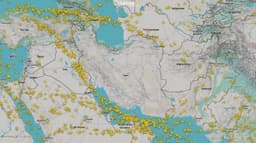
Iran’s decision to temporarily bar most commercial flights from its airspace amid threats of US military strikes in January 2026 offers the clearest historical precedent for assessing the current 26% implied probability of a full, sustained closure. That incident involved two brief shutdowns lasting under three hours each, with flights rerouted across the region before airspace reopened by 7:00 AM local time[1][4]. A similar pattern emerged during the Israel–Iran conflict in mid-2024, when multiple Middle Eastern nations closed their skies, though Iran’s restrictions remained partial and short-lived[2]. Crucially, even after large-scale US and Israeli strikes in March 2026, the Tehran FIR (OIIX) only partially reopened by June 2026, with most Europe–Asia traffic still avoiding the region[3]. These cases suggest that while Iran has repeatedly restricted airspace under pressure, a general, prolonged closure applicable to all commercial overflights remains an outlier rather than a norm.
Traders should monitor upcoming US presidential announcements regarding Iran, scheduled FAA advisories on flight restrictions in the Tehran FIR, and any escalation in regional missile or drone activity. A recent Al Jazeera report noted that Iran’s January 2026 closure was directly triggered by President Trump’s threats following anti-government protests[1]. The market’s settlement window ends in August 2026, so any new US military posture or Iranian retaliation before that date could shift odds significantly. On platform mechanics, Polymarket displays decimal odds (e.g., 3.85) while Kalshi and Betfair use implied probability (26%), creating divergent risk perceptions for identical positions. Fee structures also vary: Polymarket charges 1–2% on wins, whereas Kalshi applies no win fees but requires KYC, limiting access for non-US users. Smarkets and Betfair offer lower fees but higher KYC thresholds, further fragmenting liquidity across books.
These structural differences mean that the same 26% probability may be priced as 3.85 on Polymarket but as 26% on Kalshi, altering trader behaviour depending on fee tolerance and jurisdiction. While Polymarket permits anonymous trading, Kalshi’s KYC requirement restricts participation to verified users, reducing global liquidity. Smarkets and Betfair sit between these models, offering lower fees but stricter identity checks. For this specific market, the divergence in odds presentation and fee policy could lead to temporary mispricings, especially if US–Iran tensions escalate before August 2026.
Methodology
This page compares Iran full airspace closure by 2026? specifically across Polymarket, Kalshi, Betfair Exchange and Smarkets. The live probability is the Polymarket mid; the comparison columns summarise each venue's fee structure, KYC, settlement currency and payment rails. Every CTA routes to Kalshi Alternative UK, which mirrors the Polymarket order book at 0% fees.
Resolution & payout
Settlement is the biggest difference between the four platforms: Polymarket on-chain in USDC (instant), Kalshi USD via CFTC (T+1), Betfair and Smarkets in local currency via bank withdrawal (T+1 to T+3). On-chain settlement clears in minutes — the fastest payout path of the four.
FAQ
- Polymarket vs Kalshi — which is better?
- Depends on your location. Kalshi is CFTC-regulated, US-only with full KYC. Polymarket is global, on-chain, no KYC up to $1,500. Polymarket has ~10x higher liquidity but higher regulatory risk.
- Which platform has the deepest liquidity?
- Polymarket — by a wide margin. Top markets reach $50-500M volume, Kalshi ~$200M cumulative, Betfair similar. Deeper liquidity means your trade moves the quote less.
- What about Smarkets as an alternative?
- Smarkets is a UK betting exchange with a lower default commission (2%) than Betfair. Liquidity on political markets is below Polymarket, comparable to Kalshi. Geo-blocked in many jurisdictions.
- Which platform is accessible globally?
- Polymarket is geo-blocked in the US/UK/EU. Kalshi is US-only. Betfair and Smarkets are UK-restricted. Kalshi Alternative UK has a different geo footprint and routes to Polymarket's order book at 0% fees.
- Which platform supports Klarna/SOFORT?
- Directly: none. Polymarket accepts only USDC on Polygon. Kalshi Alternative UK offers a fiat on-ramp via Klarna or SOFORT (DE/AT/CH) and converts internally to USDC for the Polymarket order book. T+1 processing.
%22%2F%3E%3Cpath%20d%3D%22M%206%2066%20A%2026%2026%200%200%201%2058%2066%22%20fill%3D%22%23E6B98D%22%20opacity%3D%220.9%22%2F%3E%3Ccircle%20cx%3D%2232%22%20cy%3D%2226%22%20r%3D%2222%22%20fill%3D%22%23F5CBA7%22%2F%3E%3Cpolygon%20points%3D%2216%2C18%2020%2C4%2024%2C18%22%20fill%3D%22%2314b8a6%22%2F%3E%3Cpolygon%20points%3D%2224%2C18%2028%2C3%2032%2C18%22%20fill%3D%22%2314b8a6%22%2F%3E%3Cpolygon%20points%3D%2232%2C18%2036%2C3%2040%2C18%22%20fill%3D%22%2314b8a6%22%2F%3E%3Cpolygon%20points%3D%2240%2C18%2044%2C4%2048%2C18%22%20fill%3D%22%2314b8a6%22%2F%3E%3C%2Fsvg%3E) and
and%22%2F%3E%3Cpath%20d%3D%22M%206%2066%20A%2026%2026%200%200%201%2058%2066%22%20fill%3D%22%23E6B98D%22%20opacity%3D%220.9%22%2F%3E%3Ccircle%20cx%3D%2232%22%20cy%3D%2226%22%20r%3D%2222%22%20fill%3D%22%23F5CBA7%22%2F%3E%3Crect%20x%3D%2214%22%20y%3D%224%22%20width%3D%2236%22%20height%3D%228%22%20rx%3D%224%22%20fill%3D%22%2314b8a6%22%2F%3E%3C%2Fsvg%3E)
Trade Iran full airspace closure by 2026? on Kalshi Alternative UK
Live order book, 0% fees, USDC settlement in seconds.
Open live market →